Showing posts with label books. Show all posts

Sunday, July 31, 2011

Cells and biology

I recently borrowed a book from my sister who has a Master's in biology, Zoology by Dorit, Walker and Barnes, about 900 pages, intended audience is college biology students I believe. I've been reading it over the summer, and I must say it's the most interesting book I've read in years. I can't recall the last time I've learned so much in such a short time span.

The book goes through what stuff cells are made of, how respiration and cell division works, how protein compounds are made, how it is thought various solutions to problems evolved, how various features of species stem from physical limits and constraints in the environment. For instance, tiny animals don't have lungs. They don't need them because no part of their internal body is ever far from air or water. The complicated blood and lung system of humans is really an extraneous necessity required by our huge size.

The book then covers the various animal groups one by one. As it turns out, most of the stuff I at least tended to associate with humans and higher animals is really nothing new. Sex was not invented with the monkeys. Also air is a pretty inhospitable environment, as the book puts it, every animal not living in water is constantly living at the risk of desiccation.

One of the things I've learned is that the world of cells is an extremely complicated world in its own. A big animal, like a human, is really a big blob of cooperating cells, each cell being a living being in its own right, although of course dependent on the others. The cells in your foot are dependent on the cells in your mouth to swallow food and the cells in your intestine for taking in nutrients from the soup that passes through. And vice versa, no feet means no catching food, at least in nature.

It's a purpose of life, feeding your cells, and a good one I believe. But each cell is actually a pretty complex thing, with small bacteria-like sub-components called organelles like the mithocondria that take in oxygen and various other stuff and output cell fuel, ATP, not to mention the complex chemical machinery that replicates and executes the DNA code. Cells have a life of their own. For instance some cells in the body feed on the bacteria and other stuff that enters the tissue by engulfing and digesting it; that's an important aspect of the immune system.
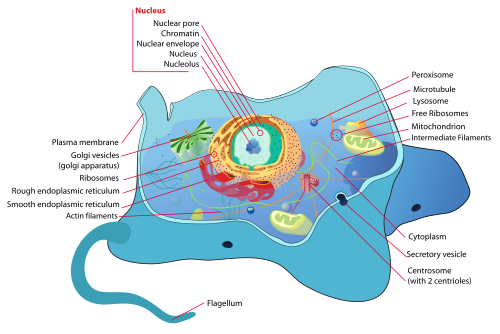
Structure of a typical animal cell (from Wikipedia)

Likewise, the interaction between the cells is highly developed, not the least keeping in mind that the chemical cell machinery must at all stages be able to self-repair. It is also grown, unlike a human-made machine in the macro world assembled from ready-made pieces, all animals and all their parts must be made from tiny single cells that collect nutrients and out of them build bigger structures.

And everything is controlled by the laws of physics and long self-replicating double-helix strands of 4-character code that specifies what happens when.

It is simply amazing.

Wednesday, March 23, 2011

Spring time!

It's that time of the year again here in Denmark.


The crocuses started flowering, and I managed to sit outside for quite a while in a short-sleeved shirt without freezing to death. There's no doubt. Spring arrived this weekend.

It's been a busy winter. I...

... managed to fall sick with flue-resembling symptoms and fever three times in 6 weeks, beginning with the Christmas holidays.

... shoveled a great deal of snow away, like last year.

... closed probably around 100 issues in the Flot issue tracker (and had the misfortune not to discover a well-meaning fork until a month after).

... mapped a big bunch of roads in OpenStreetMap, mostly centered around Janne's parents home. Thanks to the effort of volunteers, we've got aerial photos of almost the entire country and will, I think, within this year have a complete free street map of Denmark. I found out mapping is a fine hobby; it's a nice way to relax while gaining the usual open source feeling of contributing to something greater than yourself.

... read 16 books on local history of Vendsyssel and Himmerland, the regions where I live, told by old people that recount their youth around 1900-1930, mostly with farming, quite an eye-opener, really, and a great complement to the things we were taught in history lessons in school. I also read the Arthur trilogy by Bernard Cornwell (it wasn't quite as good as his Saxon book series, although maybe I'm just biased because I prefer the brought-up-as-a-Dane protagonist from those).

... wasted some time with Tremulous 1.2pre after having stopped playing Tremulous for a long time. It is a surprisingly difficult multiplayer FPS. I mostly play the alien side because I like the speed, but since I'm still not very good at it, this means I have to trick other players into coming close enough to be vulnerable.

... and annoyingly failed to get into the habit of regular piano practicing again.

Thursday, March 26, 2009

Ketil Bjørnstad

I finished reading To Music by Ketil Bjørnstad the other day.

It's mixing a realistic presentation of an young aspiring pianist and his chaotic life before his carrier starts with a sneaky, subtle weirdiness, a bit like Twin Peaks; very unnerving but at the same time funny. Of course, once I started on it, it was impossible to put down. For any interested in their general health condition, I recommend staying away. Seriously.

It makes me wonder what I look for in a book when I go to the library. My previous book was by Alistair MacLean, which today requires an humorous attitude towards his anachronistic a-man-is-man world views to read, at least for me.

Wednesday, November 21, 2007

Peopleware

I finished reading Peopleware: Productive Projects and Teams. It's about the human factor of conducting projects. Which according to the book completely overshadows any other aspects of the project, even though it's often ignored completely.

The way the book is written it's addressing project managers. But don't let that fool you. If you're somehow involved in a software project, you're also involved in the management of it. If you're not, there's something wrong - read the book to find out why.

I think the main message of the book is that you should focus on keeping the people involved in a project happy to make the productive.

Make their work fun, go to great lengths to ensure they can work together well as a team, stay out of decision making that others are in a better position to do in spite of what hierarchy suggests and avoid interrupting everyone all the time.

In doing so, you're likely to have increased their productivity by an order of magnitude more than any Methodology (as they put it) can give you. The reason is that people are not machines. If you expect them to be and make them feel that way, and this is easier to do than you might think if you come from a software background where it's all about the logics, then it shifts from high gears to low gears, the magical stuff that makes a design or a program uncover itself from nothing just by the help of human mind.

There a lot of interesting tidbits in the book too. For example, it's often postulated that you need a deadline to make people work efficiently. So okay, people are not machines, they're much worse, they need a bit of whipping to make them work hard. The book cites a study which found that people are almost twice as productive on projects without a deadline compared to projects where the project manager sets one.

Another example is that people tend to react to change in unpredictable ways. For instance, if you do something different from what you use to do, you might be more productive, not necessarily because the new way is better than the old, but simply because you expect it to be better (I guess this is the Placebo effect) or because it's new and exciting and you're generally more productive when you're excited. The authors call the phenomenon the Hawthorne effect after an experiment with illumination in a factory. Increase the lighting and people are more productive, decrease the lighting and people are also more productive.

Anyway, if you're somehow involved in software projects, or any other kind of mind-worker projects for that matter, I recommend you read this book. You won't regret it. It taught me more about my work than any other book I've ever read.

Monday, May 7, 2007

Update

Long time, no post. I finished reading Naked Economics, it didn't take me more than a week. I still highly recommend it. It did have lots of interesting points on globalisation.

One is the notion of human capital. From a macro-economic point of view, one of the best thing a country can do is to invest in its people - education, health-care and the like. The return of investment as measured in cold cash is worth it.

One example of this is the fact that countries that are rich in natural resources don't fare particularly well in the long run - because they haven't had to invest in human capital. Another example is a research facility of well-educated engineers and scientists that has to close down. A local disaster in the short run, but the engineers and scientists are highly motivated individuals that soon find something else to do. If the facility is not simply bought by a large corporation that has no other interest in the facility than its human capital.

Another point concerns one of the dark sides of capitalism. Creative destruction - those who cannot compete cannot survive. Instead of fighting this built-in ground rule, the author suggests that the transition period be made less severe by retraining the involved workers and support from the authorities. Focusing on the future instead of the past.

From the point of view of the Far East sweatshops, the author notes that the people working in these shops would not be there if it weren't for the fact that they are better than the alternatives. I think that's simplifying things (*ahem*, did anyone mention the word "exploitation"?), but nevertheless an interesting point to ponder.

In other news, I upgraded to the new Ubuntu version at work. More incremental improvements, as always.

Friday, April 13, 2007

Naked Economics

I started on Naked Economics by Charles Wheelan which is about how basic economic stuff shape our society and make the wheels go around. We had some basic economic theory in high school in the history classes, so I didn't hold my hopes too high but I've already learned some profound insights after having read the first chapter. It's a great book.

One of the first thing he writes about is the market and pricing system as a decentralised system for distributing goods. Think about it.

Having worked a couple of years on decentralised large-scale software systems for the internet, it makes a lot of sense. Centralised software systems have many scaling issues. They easily break down or are very inefficient, or both. But it's not exactly easy to construct a large-scale decentralised software system that is sustainable in the long run either. And software, as complex as it is, is nowhere near the complexity of a human society.

The book also points out flaws of capitalism and how government tries (or should try) to amend those, e.g. through taxes on goods that harm the environment and thus incurs hidden costs to all of us. I'm looking forward to some well-founded thoughts on globalisation.

So far the worst thing about the book has been the foreword by some other guy (I've never heard of him, but he's probably famous). The book would actually have been better off without it.

Wednesday, February 28, 2007

Fantasy/science fiction books

I just finished reading the Fionavar Tapestry by Guy Gavriel Kay. Borrowed the three books in one cover at the local library, in a Danish translation. I enjoyed the read, although the first book started slow. It shows that it was his first. The writing in the later books is much, much better.

Other great books I would recommend are the Hyperion series by Dan Simmons, and in similar vein the Riverworld series by Philip José Farmer. And the Foundation series by Isaac Asimov. And how could I not mention Ender's Game by Orson Scott Card.

I recently read the Earthsea series by Ursula K. Le Guin series. A bit boring at times, but otherwise good. They feel different than most fantasy/science fiction books I've read. Perhaps the gender of the author shows.

I have also read the series by David Eddings, they are not exactly great works of art. But they do their job, exciting.

I recently reread Midworld by Alan Dean Foster (it's called Grøn = Green in Danish, I didn't even know it was part of a series). I remembered it as a favourite, but was disappointed when I read it again. Too naive. I think I've had too much scientific training. It's like the Dragonlance books I used to read and really enjoy when I was young, at about the age of 15 they were simply unbearable.